I spoke at the Psychiatrie and Filosofie conference “Too Mad To Be True” in Ghent, Belgium on May 14, on “black thoughts” in depression and psychosis, in connection with themes from my creative nonfiction book Questions for Werewolves.
My talk, “A Black at Once Revelatory and Mundane,” grows out of lived encounters with depression and psychosis—experiences of a “black” that felt like oblivion, trauma, and at times a manic aperture into the divine. Through Wittgenstein’s metaphor of the eye, Louis Sass’s work on delusion, and writings on night by Emmanual Levinas, Alain Badiou, Julia Kristeva, Giorgio Agamben, Leanne Betasamosake Simpson and myself, I explore how this black resists naming yet shapes our sense of self, sanity, and love.
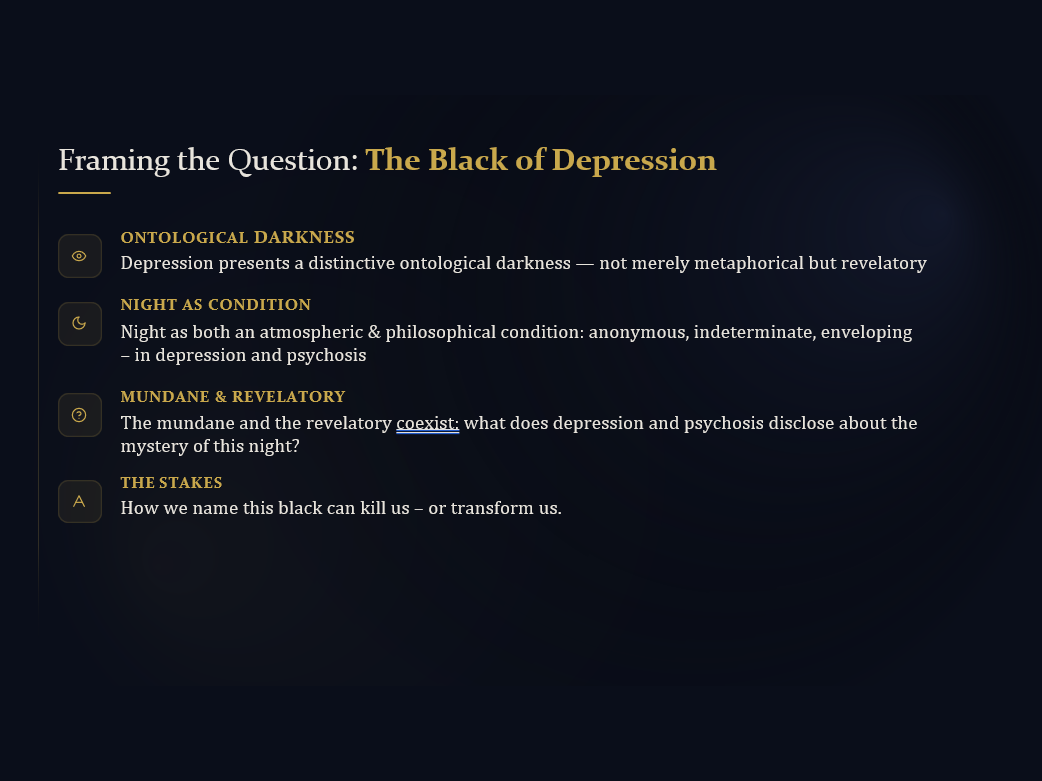
Black.
A vine twines through the winter days, cold, elusive and slippery. As if bitten by a snake, I sleep. The warmth of others cannot reach me, so let me tarry to bed a while.
Neither can I sleep. The days wash by, and beneath the foam of other people’s lives and joys, a tide recedes. I have grown old.
It is my life. It is my question. This secret, meant just for me.
Even the “happiest” of us may be undone by furtive doubts and moods of an inexpressible black nature, monotonously voiced. This dark mood, named unsatisfactorily as “depression”, leads to black thoughts. And sometimes – it is a terrifying mystery – these thoughts lead the most grievous thought of all. Of self-annihilation.
Is this black simply a wish to die? I shall not choose to name it too quickly. Especially the ineffable.
The ways we name this black can kill us.
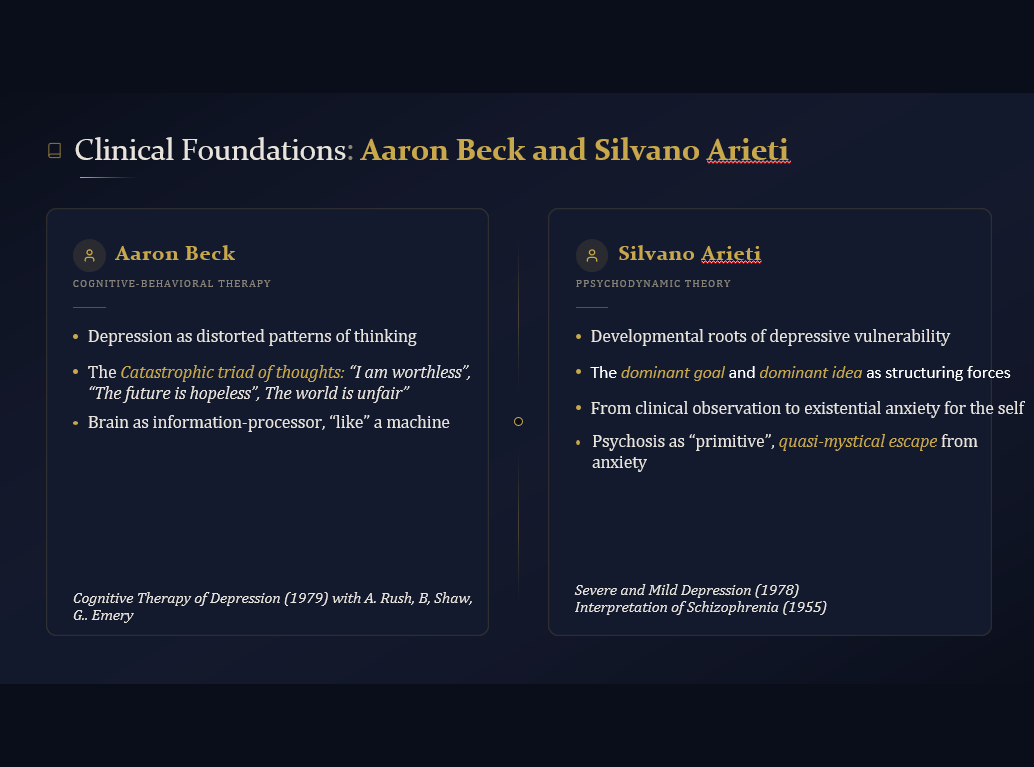
In classical cognitive behavioral therapy, the patient is coached to label black thoughts as catastrophic thinking. The brain is like an information processing machine. If only we can intervene in the mental triggers that cascade through a chain of faulty judgments into that triad of doomsday thoughts – “I am worthless”, “The world is unfair”, “The future is hopeless” – if only — then I may manage my mind before the overwhelming affect of depression sets in.
And yet, to manage one’s thoughts and triggers like a machine – can lead to feeling like a machine – to a mind alienated from the soul.
Italian psychiatrist Dr. Silvano Arieti articulated a much richer picture of depression as a complex interplay of layers of cognition and affect. For him, depression arose from a Kierkegaardian sense of despair for the self. Perhaps I – never attained the wealth, which I, as a child, imagined necessary to be loved. Or perhaps I – served dutifully as the good wife to my husband, but never lived for my own needs. Then depression is again the complex affect that represses this despair for self, where there are no cognitive solutions to a more authentically chosen life.
Dr. Arieti drew important connections between depression, psychosis and existential anxiety. For him, psychosis was a different kind of escape from reality than depression — into a more dream-like, quasi-mystical process that, at least in his early writings, he considered primitive, archaic, and delusional, albeit one he wrote that indigenous cultures seemed to have a strong grounding in.
And yet, how often the soul’s voices come from that dark, dreaming process to connect us into religio and the sacred – in ways that often don’t make sense to a rational mind? How often the soul’s wisdom comes, not as light, but as a darkness dimly groped and felt, even caressed, as from behind a black veil we cannot see?
Black.
I first encountered this in depression, in the wistful desire for oblivion or suicide. I also encountered this in psychotic collapse, as a vision of a blind spot, a gap through which I fell into a manic realm of divine, poetically “apocalyptic” signs.
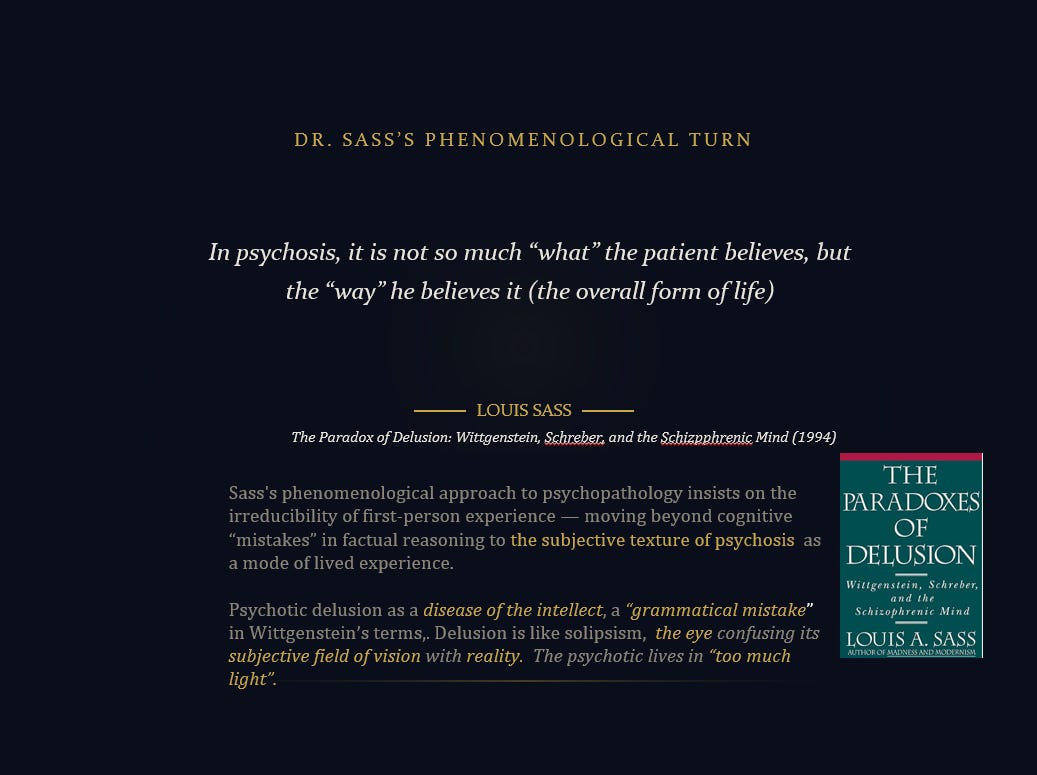
When I read Dr. Louis Sass’s early work on psychotic delusions in schizophrenia, his commentaries expressed an uncanny resonance with certain delusional aspects of my own manias, and in a perverse way, my own depressions as well. He proposed: perhaps the disturbance in the mad person is not so much about what the patient believes, so much as the way he believes it: the way the world lights up for the psychosis as a private cosmos of impressions that are immune to social reality.
A couple of examples: In the famous psychiatric case of Dr. Schreber, the good patient, looking in the mirror, insistently sees his bosom “as a woman’s” illumined by mysterious rays of light he knows he can see but the medical staff cannot. In another scene, Dr, Schreber sits in a garden, and amazes himself that the mosquitoes around his face are miraculously produced by his own mind, ex nihilo. “Everything that happens in the world is in reference to me.”
For Dr. Sass, this quasi-mystical air of psychosis can be dispelled as a kind of grammatical nonsense, akin to the attitudes of solipsistic reasoning that philosopher Ludwig Wittgnestein, through his later writings, seemed intent to cure. Dr. Sass used Wittgensteins’s metaphor of the retina of the eye to clarify.
“The eye nowhere appears in its field”, sees everything except itself. Here “eye” is taken to be a metaphor of a self, a cogito, an ‘I’ in relation to a world held in reserve. In an psychotic, detached and depersonalized state of mind, the eye may begin to confuse reality with the impressions the eye itself constructs.
What appears revelatory to the psychotic—that the “I” sees —is, in truth, quite ordinary. It is merely a shift in grammatical position –not a genuine mystical disclosure.
Dr. Sass used this line of thought to argue that psychotic delusion can be seen as a disorder of “too much light” of the I. The mystical aura surrounding psychosis dissolves once we see it as an over‑intellectualized, excessively self‑reflective mode of thought rather than a portal to hidden mystical truths.
And yet he emphasized, there is a peculiar terror that comes with this kind of psychotic solipsism:
that i close my eyes and the world will no longer be there for me to see
from my own book, Questions for Werewolves
That I create the true and mystical world entire, and yet the world is forfeit if I lose sight of it. This is one of the terrors of psychosis. A euphoric sense of oneness can open into an abyss. A darkness eats away at the mind’s totality of light. Madness does not escape the night.
The night, for Dr. Sass, is errant. It is a collapse of solipsistic light into a depersonalized abyss.
It is this sense of black that I wish to challenge.
Let me adopt the metaphor of the eye to elaborate on a “blind spot” in being, knowledge and language. Let me perform this blind spot, not simply in its errancy, but its imbrication with love and fidelity – a black at once revelatory and mundane, by which the mad person may cohabit with depression, sanity and the sacred.
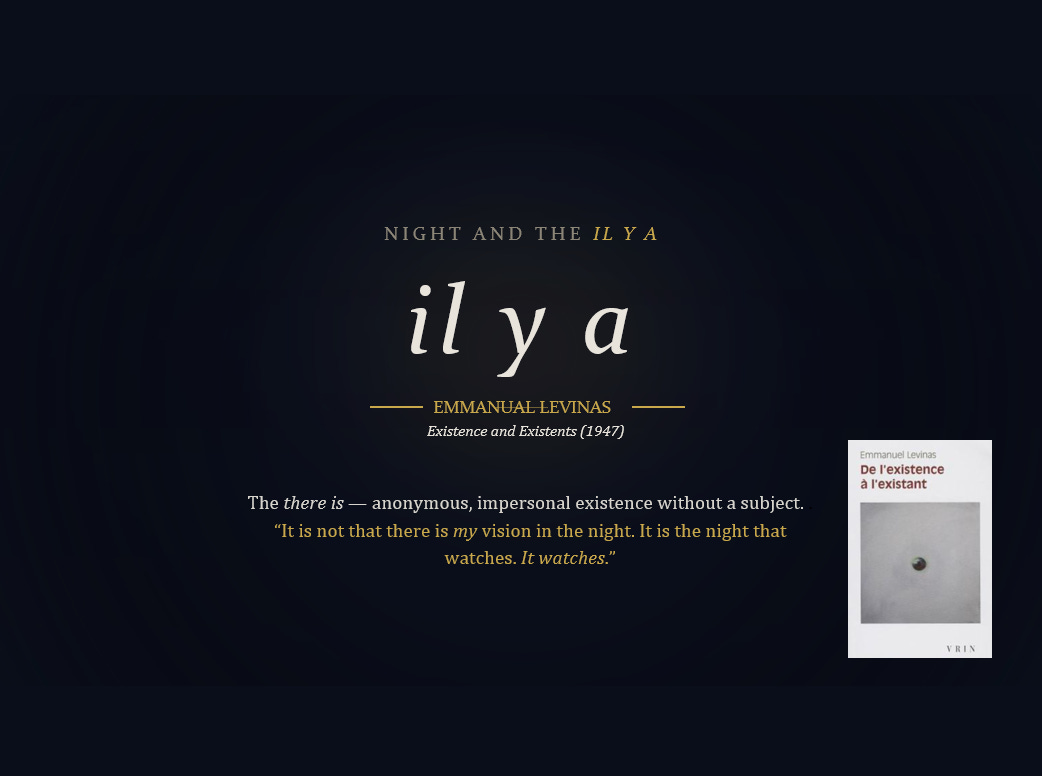
Let me suture an overlap between Dr. Sass’s themes and the early writing of Emmanual Levinas in Existence and Existents. Levinas too wrote about light, night and depersonalization of the self.
In the phenomenological method of Husserl and Heidegger, the mind as ‘I’ may hold the world in reserve and range “solipsistically” over its domain of vision, to observe impressions and observe its experiential structure. Yet for Levinas “The world and light are solitude”, and does not open to the other, but to subjective will and feeling, as well as to a sense of the world as tool, as ready-to-hand and disposable.
For Levinas “What we call the I is itself submerged by the night”. He illustrated this with insomnia. In the late sleepless hours of racing thoughts, “It is not that there is my vision in the night. It is the night that watches.It watches.” And “all the thoughts that cross my mind are suspended on nothing. They have no support.” Insomnia touches upon a horror of night, as an “impossibility of escape”. The dark is not about death of self or physical life, but rather a de-personalized infinity “Darkness is the very play of existence which will play itself out even if there be no one.
But – and this is his mystic hope – the dark can also open into a revelatory time, another alterity, and a radical and infinite openness to others, to the sacred. There is not me with myself. There is, But for Levinas, this ‘there is” can open to a deeply ethical and sacred character: The dark – in its connections to the body, to sleep, to the elemental in nature, and to the disappearance of my self (or I).
The dark opens to the darkness of the body, the vulnerability of others, and a mystical sense of time. Writing in 1947 before indigenous mental health became a thing, he wrote very affirmatively of indigenous religion: “’Primitive men’ (my scare quotes) live before all Revelation. before the light comes in”.
Then, the black of annihilation may be understood differently than suicide — and let me finally use this word “suicide”, now that there are alternatives. The black may open to infinite, nakedness of the vulnerable other. And even the possibility of a redeemer, a consoler of the world we share together.
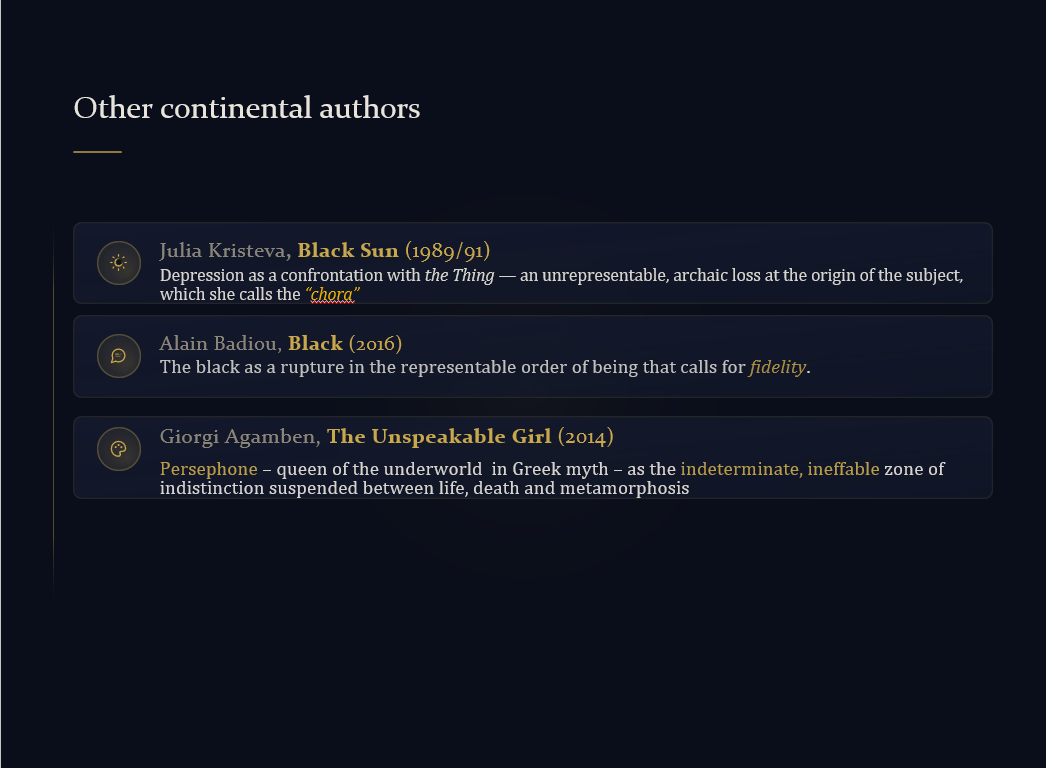
Other post-structuralist writers have made night their theme – Badiou, Kristeva, Agamben.
Badiou named the black as “void”, an unrepresentable register of being that nevertheless required of one the greatest fidelity and even love. Kristeva named the black as “chora”, an unrepresentable meaning-making process outside of the order of symbolic language, that she connected to the womb. Agamaben, in his monoghraph on Persephone, queen of the underworld, interpreted her as the ineffable “zone of indistinction”, or bare life, suspended between life, death and metamorphosis
I do not have time in this short talk to delve in depth, but if we follow these writers, then, from night, there may issue all our higher, infinite commitments to spititual love and fidelity, art, ethics and transformation.
The mystical – is what cannot be cognitively mapped, what makes no sense. As Wittgenstein wrote, “Whereof we cannot speak, we must remain silent.” But it is not thereby without faith or truth.
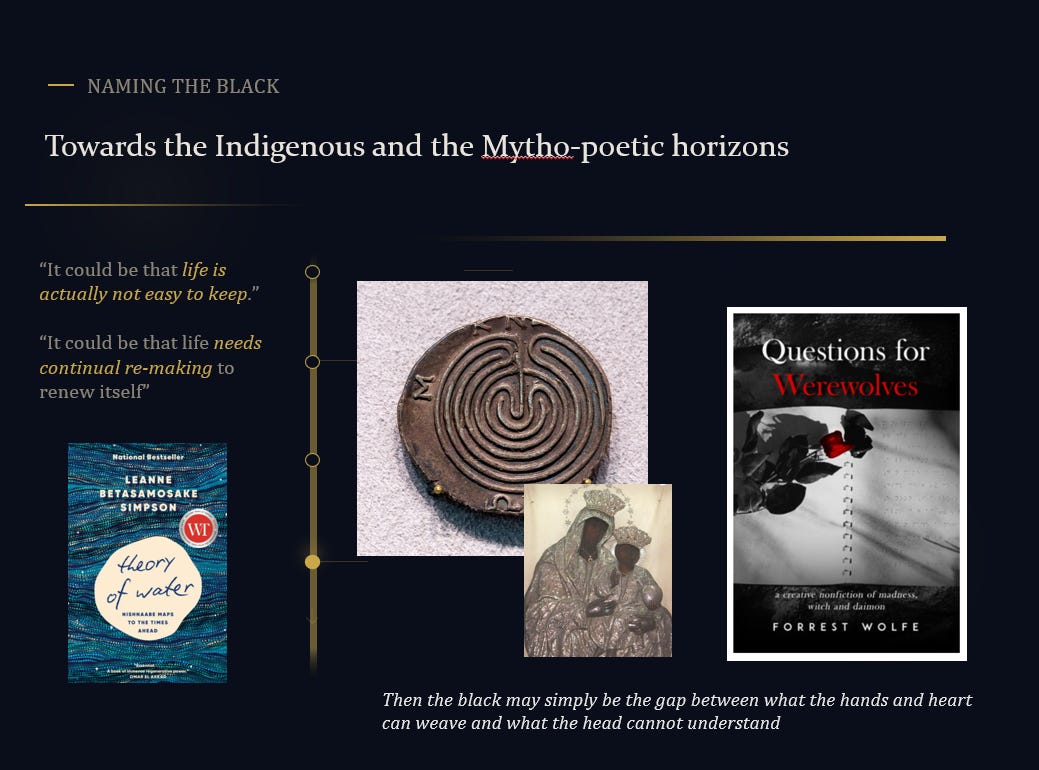
Let me, in my concluding movement, invoke a more mythical time. But let us not get caught up in the hypostates of myth, but the dark visionary night that effectuates myth. And in so doing close back on the circuit of depression and the black.
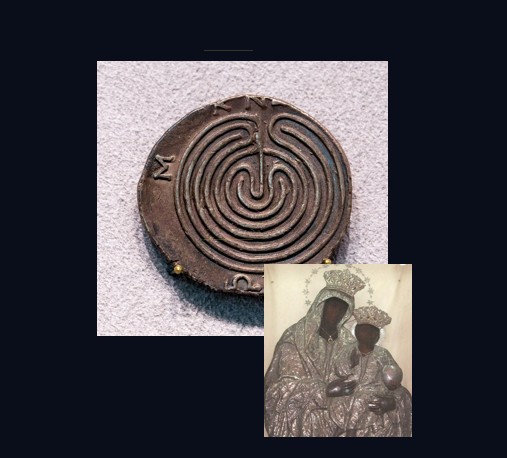
For me, depression is an odyssey into the center of a labyrinth. There the minotaur awaits. There, your life and your death, as you have known them, are very much at stake. There, as Nishnabe author Leanne Betasomake Simpson writes, “It could be that life is actually not easy to keep.”
Not simply my own life, but the life of the world.
But in the center of the labyrinth is a turn that leads back out, like Ariadne’s golden thread . Not everyone finds that turn in the center. You grope in the dark, more by feeling than by thinking. A prayer, a candle, a good deed, a dancing, a ceremony. By heart and hands, rather than head. Through deeds, rites of remembrance, and good intentions, to re-world the broken world entire, not just for me, but for others.
“It could be that life needs continual re-making to renew itself” (Leanne Betasomasake Simpson) Then new kinds of thinking may grow out of hands and heart. Hands and heart weave what the head cannot. By a sensibility that seems dark, when the “I” cannot see.
The black summons the mad person to go through it, to become other, and thereby – not through his own efforts – but a kind of grace redemption, to be resurrected, and to repair the world.
Then the black may simply be the gap between what the hands and heart can weave and what the head cannot make sense of. This mystical horizon, to me, is an indigenous horizon, a mythopoetic horizon, and the infinite horizon of the time to come.
Thank you to Jasper Feiyarts, who is a close collaborator of Louis Sass, for clarifying to me that Dr. Sass’ views have evolved over the last three decades since the pubication of the book cited here.
Since the Q&A was quite robust, with thoughtful questions from Dr. Wouter Kusters, Dr Jasper Feiyarts, Dr. Anna Six and others, I have reproduced them to the best of my memory here, and improved on the diction of my answers.
Q&A
Q: What advice would you give someone who is caught in this situation, in the labyrinth of abysmal depression, as far as practical tips.
A: I am very much inspired by indigenous ways of knowing, where,as Leanne Betasamosake Simpson writes, “heart” and “hands” can lead where the “head” does not understand. Without speaking for their traditions, I would contrast this with cognitive psychiatry — where cognition (the “head”) is presumed to lead affect ( the “heart”) and volition (“the hands”)
So, someone caught in the center of the labyrinth might — with a faithful and receptive intention — wait for signs and voices. Then hands and heart may weave these threads into a new beginning: through rite and ceremony to re-world a new beginning to the world again.
That seems to me part of the genius of indigneous ways.
Q: What is the critical edge by which you are using Levinas’ notion of Night to critique Sass’s work?
A: To my mind, (at least in this stage of Dr. Sass’s writing), for Dr. Sass, the night does not have any deeper mystical meaning. The night is a kind of abyss that arises where a psychotic’s solitary experience of light collapses like a house of cards.
Whereas for Levinas, the night is a deeper and more fundamental “ground” than light, and can open to a mystical encounter, as well as to the body, and to the vulnerbael other. I t does not necessarily escape solitude (for instance, in insomnia), but Night can open to a deep experience of alterity, the revelatory and prophetic in a way that it does not for Dr. Sass.
Q: Can you say more about time, the temporality that you speak of?
A: Levinas gave a rich evocation of a messianic time that might open, not at the end of history, but in the present. The present itself is mystically convolved with the past that is resurrected, together with the future that redeems it, in this instant. Time has a revelatory and prophetic dimension that it does not in our economic and chronological sense of linear time.
Q: What are the larger implications for our age where the world has been electrified, night has disappeared into transparency, spectacle and the light of rationality?
A: Well that ties into a much larger Levinasian critique that may be beyond the scope of this talk. Levinas was critical of the phenomenology of Husserl and Heideggersort. He thought both of these “heremeneutics of light and Being” framed the world as disposable and failed to escape the solipsism of the subject. Indeed, he was writing in 1947 just after the Holocaust. In his later writings (Totality and Infinity), he thematically connected the hermeneutics of the subject to totality and genocide. But that is beyond the scope of this talk.