I am honored to speak at Morbid Anatomy Online in June, on “Dionysos & the Sadness of Our Times – matriarchal and Orphic connections”. This talk elaborates in a more scholarly way some themes from my upcoming book Questions for Werewolves.
Morbid Anatomy is a unique and learned forum, named under the motto *memento mori*, for the gathering of diverse artists, mythologists, archetypal psychologists, esoteric scholars, literary critics, poets, heretics, postmoderns and feminists — all involved in the making or discussing of the metaphysical-literary.
https://www.morbidanatomy.org/events/2026/6/22/rx6z5la1l1r6vpfiog4uzwhughun2d
Abstract Proposal
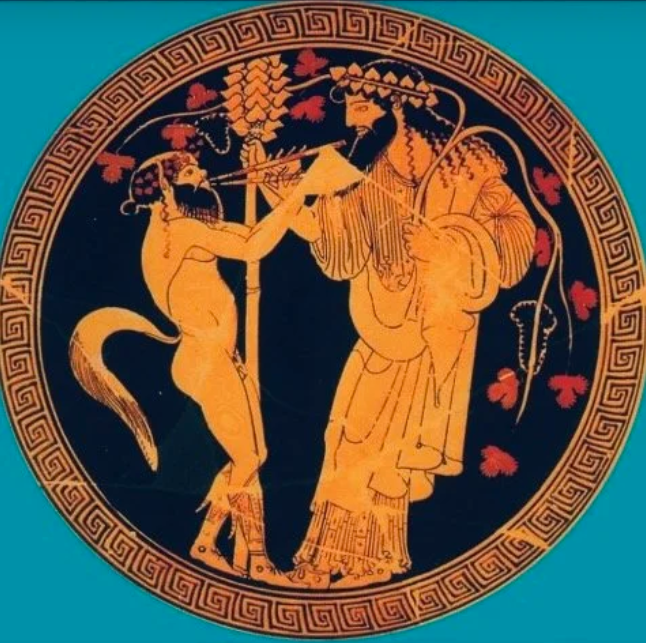
Dionysos emerges as one of the most enigmatic and enduring figures of ancient Greek religion, a mystery cult deity whose presence stretches from Minoan civilization around 1700 BCE through the Roman era. Associated with women, snakes, goats, bulls, wine, and women’s madness, Dionysos dissolved boundaries—between life and death, human and animal, destruction and renewal. Carl Kerenyi famously described him as “the archetype of indestructible life,” a being whose mythic pattern centers on death, dismemberment, and miraculous resurrection. Kerenyi emphasizes Dionysos as mystery sustained primarily by women.
Following Kerenyi as a guide, this talk will trace the figure of Dionysos back to Minoan religion, where the god’s epiphanies co-evolved with ancient matriarchal goddesses who later shaped the Eleusinian mysteries of Demeter and Persephone. In this view, Dionysos cannot be understood apart from his opposite: these chthonic goddesses of life, death, and rebirth. We will look at Dionysos’ genealogical connections to Ariadne, Persephone/Semele, the Delphic oracle, and the origins of Greek tragedy and comedy.
We will also examine Kerenyi’s understanding of the masculine within Dionysian religion, and how Orphic traditions sublimated his mysteries into a more masculine mode that engendered the doctrine of the immortal soul, which Plato and Christianity would take up.
By feeling our way through the Dionysian atmosphere of mystery with Kerenyi, we may find new ways to summon a Dionysian response to our collective depression and ecological catastrophe today.